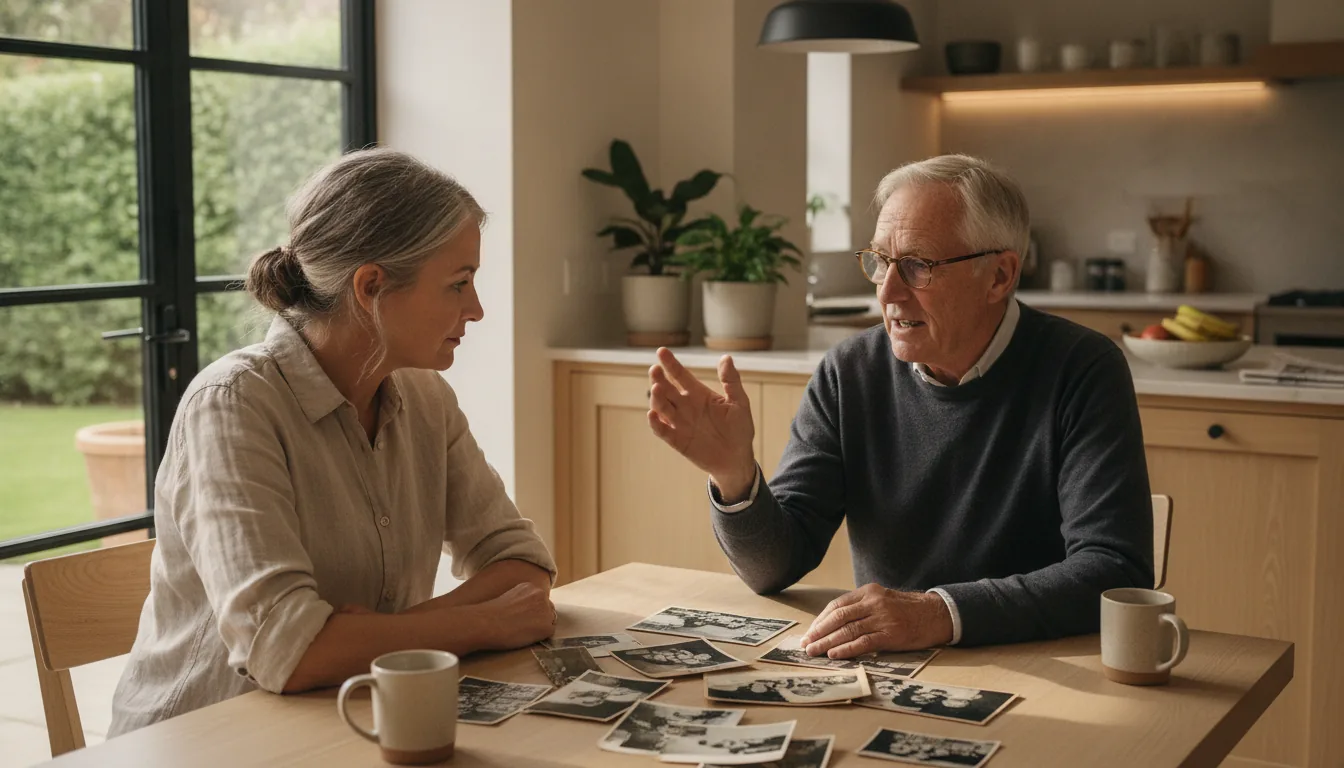
The most effective way to get an elderly parent to talk about their past is not to ask them to. Not directly, not first. The conversations that produce real stories usually start somewhere else: with a photograph left on the table, a question about a place they once mentioned, or a story you tell first, about your own memory of them. The direct approach – "Dad, I want to record your life story" – tends to produce short answers and polite deflection, because it frames the conversation as an interview, and very few people talk naturally in an interview.
In brief
- Don't open with "tell me about your life" – the question is too big and produces thin answers
- Photographs and objects are more effective openings than questions, and there is good research behind why
- Use "tell me about a time when…" rather than "what was X like?"
- Always ask permission before recording – then make the device unobtrusive, not hidden
- If they say their life "wasn't interesting", the ordinary detail is precisely what has value
Why the first conversation usually fails
Most people who try to record a parent's stories start the same way. They sit down, they say something like "I'd love to hear about your childhood," and they get fifteen minutes of polite, compressed summary. Date of birth, school, a vague outline of work. Nothing they didn't already know. Then the conversation runs out of road and everyone feels slightly awkward.
This happens because the question covers too much ground. "Tell me about your childhood" is the equivalent of asking someone to summarise a novel. The answer will be short, because there is no good long answer – only more novels. What opens people up are specific, concrete prompts: a name, a place, an event, a detail small enough to actually step into.
It also helps to understand why elderly parents deflect. Most of the time it is not reluctance to share. It is a quiet belief that their story isn't interesting enough – that a life spent working, raising children, paying bills and getting on with it doesn't qualify as something worth recording. They are wrong, as we'll come to, but the belief is genuine, and contradicting it directly rarely helps.
Five things that work
Start with an object. Bring something into the room before any conversation begins: an old photograph, a piece of jewellery, a tool they used at work, a document from a drawer. Leave it on the table. Let them notice it.
This is not just folk wisdom. Researchers have used photographs as interview prompts for decades – a method known as photo elicitation – precisely because images do something questions cannot. Work on cued recall describes photographs as catalysing a chain that runs from recognition through emotion to narrative: the image surfaces a detail, the detail brings a feeling, the feeling produces a story. "Where was this taken?" reliably outperforms "tell me about yourself" because it gives the person somewhere to stand that isn't themselves.
Tell a story first. Share a memory you have of them – something specific and small. "I was thinking about that time you took us to Whitby, the year it rained the whole weekend." This sets a register of casual, imprecise memory and signals that you're not expecting a polished account. It also demonstrates the scale you're interested in: not grand narrative, just moments.
Ask about a time, not a topic. "What was school like?" is a topic question and produces a summary. "Tell me about a teacher you remember" is a time question and produces a story. "What was work like?" versus "can you remember your first day?" – the grammatical shift is small and the difference in what comes back is large.
Let them tire before you do. Conventional oral history interviews often run to an hour or two, and if your parent is enjoying themselves there is no reason to cut things short. But if they are reluctant, easily fatigued, or the first attempt went badly, a short first session is a lower bar to clear and makes a second one far more likely. Ending while there is still something left to say is rarely a mistake.
Bring a third person. Parents who deflect one-to-one sometimes open up in a trio, particularly if the third person is a sibling, an old friend, or a grandchild asking out of genuine curiosity rather than filial duty. There is less pressure to perform, and other people ask things you wouldn't have thought of.
Asking permission to record
Ask directly, before you start, and be specific: that you'd like to record the conversation, what you intend to do with the recording, and who will hear it. Then let them say no to any part of it.
This matters more than it might appear. The Oral History Society's guidance on informed consent is unambiguous that consent must be freely given on the basis of full information about how a recording will be used and stored, and that it can never be inferred from silence. Recording someone without that – even a parent, even with good intentions – is ethically wrong and, depending on what you do with it afterwards, can be legally serious.
The good news is that consent and comfort aren't in tension. What makes people self-conscious is not knowing they're being recorded, it's being reminded of it. So get explicit permission, then make the device unobtrusive: a small recorder rather than a phone propped against a mug, placed out of the direct eyeline, started before the conversation properly begins. Most people forget about it within a few minutes. That is a completely different thing from concealing it, and it works better.
"My life wasn't interesting enough"
Many parents say some version of this. Contradicting them – "of course it was interesting" – tends to feel patronising and changes nothing. It is more effective to take the statement literally and answer it specifically: "I'm not after interesting. I want to know what things were actually like. What did you have for breakfast when you were ten?"
There is also a straightforward evidential answer. Psychologists Marshall Duke and Robyn Fivush at Emory University developed a measure called the Do You Know? scale – twenty questions testing how much children knew about their family's history. How much a child knew turned out to be one of the strongest available predictors of their self-esteem and emotional wellbeing, a finding that held up when the researchers revisited the same children after the events of September 2001.
The detail that matters most here: the stories that did the work were not the triumphant ones. Duke and Fivush found the strongest effects came from what they called oscillating narratives – accounts that moved through hardship and out the other side. Difficulty followed by recovery. Which is to say that the very ordinariness your parent is apologising for is closer to the active ingredient than the highlights would be. What the kitchen smelled like. What they were frightened of. What they wanted to be, and what got in the way.
When it keeps not happening
Some families find these conversations work better when they aren't doing them alone. The loaded dynamic between a parent and an adult child – the history, the patterns, the things habitually left unsaid – can make it genuinely harder for both sides to be natural. This is part of why guided memoir services like Chronicle work: an interviewer with no stake in the family relationship can ask what feels too direct, hold a silence, and steer without the layer of obligation.
For the questions themselves, our list of prompts built for this kind of conversation is a good starting point. And how to interview your parent covers the fuller picture – preparing, recording, and deciding what to do with what you gather.