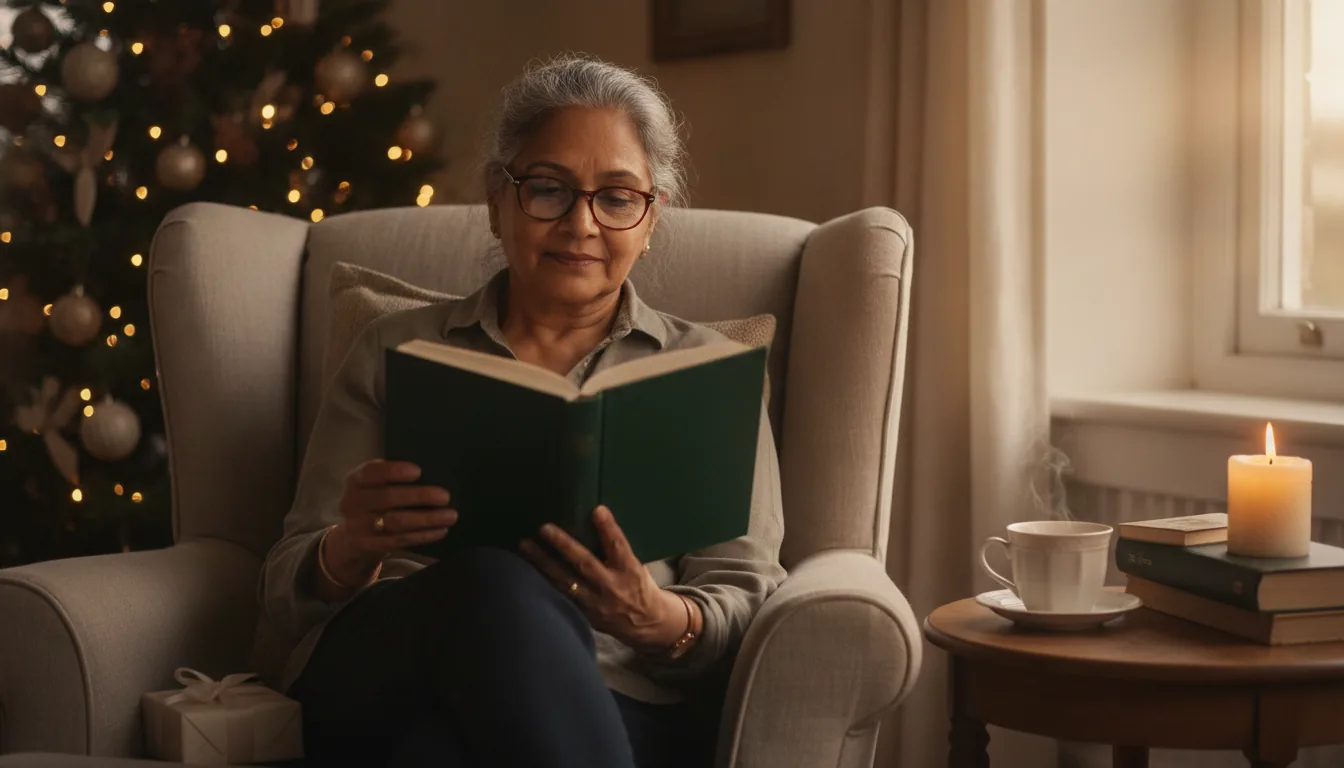
The most meaningful Christmas gift for an elderly parent who has everything is not something you can find in a shop. The usual options — a cashmere scarf, a hamper, a gadget they will politely put away — are thoughtful enough, but they tend to disappear. Opened, appreciated, set aside. By February, most people who gave a beautiful thing for Christmas cannot quite remember what it was. The gifts that stay in the family, that get mentioned years later, that quietly change something between the person who gave them and the person who received them, share one quality: they are permanent. They are made of something that doesn't fade.
In brief:
- The best Christmas gifts for elderly parents who have everything are the ones that cannot be wrapped.
- Objects — even generous, well-chosen objects — tend to disappear after the occasion.
- Experiences are better, but they end; the gifts that last are the ones that become permanent records.
- A preserved life story is in a different category: it grows in value with every year that follows.
- Christmas is one of the most natural moments to begin, because the family is together, conversation flows, and time feels briefly abundant.
Why Christmas changes the gift-giving problem
At some point in a parent's later years, the relationship between giving them things and pleasing them quietly inverts. They have accumulated a lifetime of objects. The kitchen is full. The wardrobe is full. Another physical object, however lovely, tends to add to a pile they are quietly starting to think about reducing. The relief of receiving something that doesn't need a home — doesn't need dusting, doesn't need charging, doesn't need to be fitted in somewhere — is more real than most gift-givers expect.
What they do not have enough of — what almost nobody in later life has enough of — is the feeling that their story is being taken seriously. That the things they have lived through, the choices they made, the decades they navigated, are considered worth keeping. Christmas is one of the few times in the year when the family gathers, when conversation slows, when there is more time than usual to sit across from someone and actually listen. That is the resource most worth giving.
What actually lands at this stage of life
The gifts that get talked about months later share a pattern. They tend to be relational — they involve the giver, not just the recipient. They tend to be about the person's life and identity rather than their current comfort. And they tend to produce something that persists beyond the occasion itself.
A portrait can do this, if it's executed with real care. An experience — a trip to somewhere meaningful from their past, a gathering of everyone they love in the same room — can do this. And a properly preserved life story: their voice, their memories, their account of the things that shaped them, structured and bound into a book the family keeps — does it in a way that nothing else quite matches.
The reason is specific. A life story works as a Christmas gift because it is not about Christmas at all. It is about the whole of a life. The occasion is the prompt, not the subject. What the family ends up with, once the sessions are done and the book arrives, is not a Christmas memento — it is a record that will matter in twenty years, and in forty, in ways that are impossible to fully anticipate now.
The practical question: how to give it
The thing most people find slightly awkward is how to propose this. It can feel presumptuous — as though you're suggesting your parent has unfinished business, or that you're already thinking about the years ahead in a way that's uncomfortable to name. In practice, it almost never lands that way.
Most people — once someone has done the thing of actually asking — feel relief. They have wanted to be heard. They have stories they have been carrying for decades with nowhere particular to put them. The gift is not really the sessions or the book. The gift is the permission to be listened to properly.
The simplest framing is to make it about what you want rather than what they need. I want to know more about your childhood. I want your grandchildren to know who you were before you were their grandmother. I want us to have something we can all keep. That framing almost always lands better than anything that implies time is running out — even when it is the same underlying impulse.
The timing matters too. Christmas is a good moment to introduce the idea because the family is already in the room. The conversation can happen naturally, with other people around who are equally interested, rather than as a pointed one-to-one request.
A meaningful Christmas gift for an elderly parent who has everything: what this actually looks like
A Chronicle memoir is built for exactly this kind of gift. Guided sessions — at whatever pace suits the person being recorded — move through the arc of a life: childhood, education, work, love, the decades that shaped them. The person doesn't need to be a writer, or comfortable on a microphone, or inclined towards self-documentation. They just need to talk. The sessions are unhurried and structured around them. The result is a printed book — a proper physical object, designed to be kept — that the family can pass down.
The sessions happen over weeks or months, in the background of ordinary life. There is no single sitting that carries the weight of having to capture everything. The material accumulates. The book arrives. And what is inside it — the stories, the particular phrasing, the details your parent thought too small to mention but that turn out to be the most vivid things — is permanent in a way that almost nothing else you could give at Christmas will be.
Find out how Chronicle works, and look at the tier options to get a sense of what's involved. Most people giving this as a Christmas gift begin with the Memoir tier — guided sessions, a printed hardback, a family record made to last.
Further reading: The best gifts for elderly parents who have everything · The most meaningful 70th birthday gift ideas