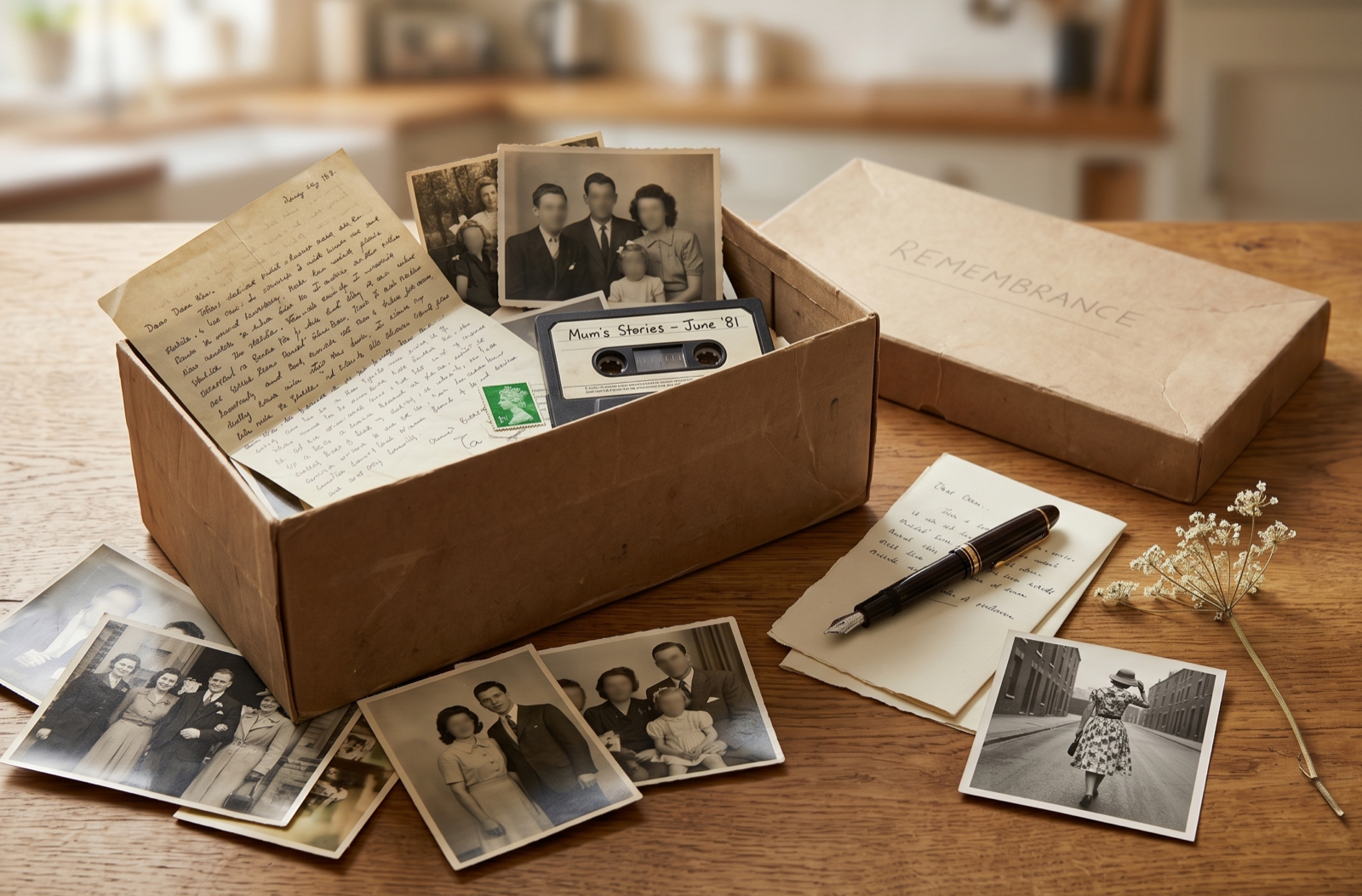
Somewhere in most family homes there is a box. It contains photographs without names on the back, a cassette tape of an interview someone started and never finished, a VHS labelled with a year and a first name but no context. The intention was there. The follow-through wasn't.
In brief
- Most family history projects start with enthusiasm and quietly stall.
- The problem isn't technology – it's the absence of structure.
- Three factors separate finished records: structure, repetition, and voice.
- Genealogy captures facts; only a memoir captures lived experience.
- Chronicle is built around all three of those factors.
Preserving family history is one of those tasks that feels important enough to think about and too large to actually do. Every year it stays on the list, a little more is lost.
Here is an honest account of the approaches people try, how well they work, and what the evidence actually says.
The approaches and their limits
Phone recordings. The most common starting point. Inexpensive, always available, and almost universally abandoned after one or two sessions.
The recordings sit on a phone that eventually breaks or fills up. If they survive, they're rarely transcribed, rarely edited, and rarely listened to by the next generation. The problem isn't the technology – it's the absence of structure.
Without a framework, conversations meander, the important questions don't get asked, and the result captures the surface rather than the depth.
Video interviews. Better than audio in some ways – the face and voice together carry more of a person than voice alone. But the same structural problem applies. Video is also harder to archive reliably, harder to search, and harder to pass on in a form the next generation will actually engage with.
Journals and diaries. Valuable when they exist; almost impossible to start from scratch. Writing about one's own life requires a sustained habit and a willingness to be honest on the page that most people find difficult.
Diaries written specifically "for the grandchildren" often read as performative. The best family journals are the ones no one expected anyone else to read.
Professional biography services. These exist and some produce excellent results. They typically cost several thousand pounds and involve a professional writer conducting extended interviews and producing a polished manuscript.
For families where this is feasible, it can be extraordinary. For most families, the cost is prohibitive and the experience feels remote – the finished book reflects the writer's voice more than the subject's.
Genealogy services. Ancestry.co.uk, Findmypast, and similar platforms are excellent for records – births, deaths, marriages, census data. What they don't capture is lived experience. They tell you where someone was born, not what it was like to be them.
A direct comparison
Oral history scholarship has consistently shown that structured interview projects produce several times more usable material per hour than unstructured recordings, with markedly higher completion rates. The presence of a clear, question-by-question framework is the single biggest predictor of whether a family history project will actually be finished.
| Method | Strengths | Limitations |
|---|---|---|
| Phone recordings | Free, immediate | No structure; rarely revisited; easily lost |
| Video interviews | Captures face and voice | Hard to archive; harder to pass on |
| Journals and diaries | Authentic, intimate | Require a sustained habit; rarely started in later life |
| Professional biography | Polished, complete | Several thousand pounds; reflects the writer's voice |
| Genealogy services | Excellent for records | Captures facts, not lived experience |
| Chronicle | Structured, voice-preserving, written chapter per session | Requires a short, regular commitment over a few months |
What actually works
The research on oral history preservation points to three consistent factors: structure, repetition, and voice.
Structure means the conversation has a shape – questions that move through a life systematically, that invite reflection rather than summary, that go back when something important surfaces mid-sentence.
Repetition means multiple short sessions over time, not one marathon recording. Memory works in layers. The second conversation about a decade surfaces things the first one didn't.
Voice means the final record sounds like the person, not a polished summary of them. The particular way someone expresses themselves – their pauses, their turns of phrase, the way they qualify everything or commit to nothing – is inseparable from who they are.
A well-structured, repeated, voice-preserving process produces something no other approach does: a memoir that reads as a whole life and sounds as a particular person.
Starting before you're ready
The most common mistake is waiting for the right moment – a significant birthday, a quiet period, a time when there's less going on. The right moment doesn't arrive on its own. Family history work starts when you decide it starts.
The second most common mistake is treating it as a project with a beginning and end, rather than an ongoing practice. The families who end up with the richest records are the ones who built it into ordinary life – a conversation once a month, a question asked over dinner and written up afterwards.
How Chronicle helps
Chronicle provides the structure, the repetition, and the voice – the three things research suggests matter most. A guided sequence of questions moves through a life over a series of short conversations, and each conversation becomes a written chapter in the person's own phrasing. Over a few months, the chapters become a complete memoir, printed and bound.
Frequently asked questions
What's the difference between genealogy and family history?
Genealogy is the record of who was related to whom – names, dates, places. Family history is what those people's lives were actually like. Genealogy can be reconstructed from archives long after a person is gone; family history can only be captured while a generation is still able to tell it.
How do I get started preserving my family's history?
Begin with one person and one question. The first conversation almost always uncovers two or three more. A structured guide – whether a published interview workbook or a tool like Chronicle – makes the difference between a project that finishes and one that doesn't.
How long should each interview or session be?
Thirty to forty-five minutes is the sweet spot. Long enough for an answer to breathe; short enough that the person doesn't tire, and so that there's something to return to in the next session.
What if some family members aren't comfortable being recorded?
You can still capture an enormous amount through written summaries, notes, and second-hand recollection from people who knew them. A memoir doesn't need every voice at once; chapters can be added over years.
Is family history worth doing if I don't have famous or dramatic relatives?
Yes – perhaps even more so. The historical value of personal history lies in the ordinary. What was life like in your great-grandfather's village in 1932? That detail isn't in any archive, and it disappears the moment the last person who lived it stops being asked.
Chronicle provides the structure, prompts the right questions, and produces a written chapter from each conversation. The result builds, over time, into a complete life story. See how it works →