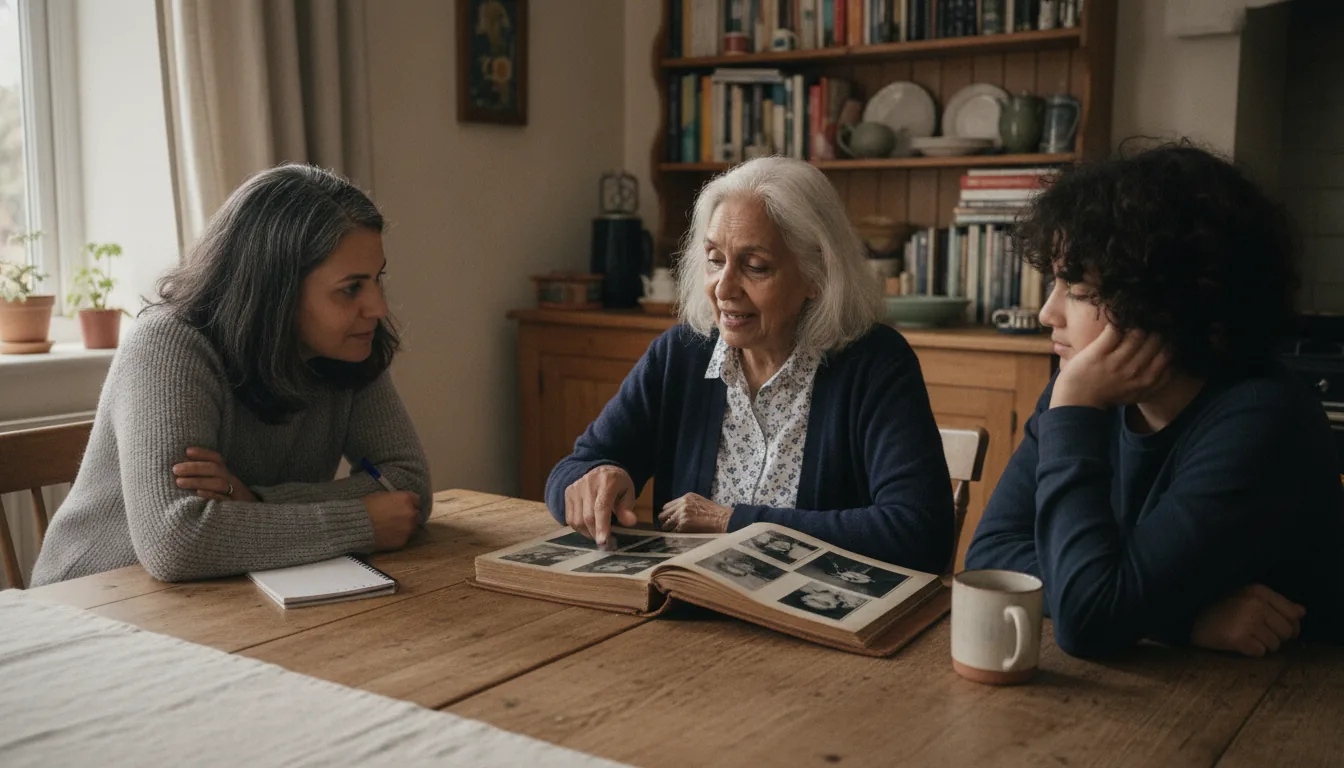
The best family history interview questions are the ones your relative has never been asked before – the ones that open a pause, a smile, a story you didn't know existed. Most families never ask them. Not because they don't care, but because nobody sits down and asks: what, exactly, do I want to know?
These twenty questions are designed to answer that. They are grouped by theme, each one chosen because it tends to surface the kind of specific, vivid material that makes a family history actually readable – and actually worth preserving. They are not a checklist to work through in order. They are starting points. Follow where they lead.
In brief
- The best family history interview questions are specific rather than open-ended – they invite a story rather than a summary.
- Group them by theme (childhood, work, relationships, values) and let one answer lead naturally to the next.
- Record the conversation – audio is enough, and it captures things a transcript never quite does.
- You do not have to ask all twenty. Two or three good questions in one session are more valuable than a rushed run through the whole list.
- The material you gather becomes the foundation of a life story – something the next generation will be glad exists.
Before you begin
A family history interview works best when it doesn't feel like one. The word "interview" implies formality – a recorder on the table, questions read from a list, someone performing their answers. What you want instead is a conversation that happens to be captured.
A few practical things help. Sit somewhere the person is comfortable, ideally in their own home. Let the recording device sit quietly to one side rather than centre stage. Start with something you already half-know – "Tell me more about how you and Mum met" rather than "Tell me about your love life." Starting on familiar ground gives both of you somewhere to ease in before the less-rehearsed stories emerge.
And don't be afraid of silence. A pause after a question often means the person is reaching for a real answer, not a ready one. The real answers are what you're after.
Childhood and place
1. What's the first memory you're certain is actually yours – not a story you've been told?
This question cuts through the family mythology and gets to something genuine. The answer is almost always specific – a smell, a room, a particular afternoon – which is exactly the texture a family history needs.
2. Describe the house you grew up in. Take me from room to room.
Spatial memory is remarkably durable. People who struggle to remember dates often remember rooms in perfect detail. This question tends to produce long, vivid answers – and often pulls other stories along with it.
3. Who was the most important person in your childhood outside your immediate family?
Teachers, neighbours, grandparents, a family friend – the answers here reveal the wider world your relative grew up in, and often surface relationships that have never been mentioned in family conversation.
4. What did your parents want you to be when you grew up? And did they ever say why?
This question sits at the intersection of family expectation and personal identity. The gap between the answer and what actually happened is usually where the most interesting material lives.
5. What was ordinary life like when you were ten? What did a normal weekday look like?
The texture of daily life in another era is one of the most valuable things a family history can preserve. Meals, journeys, money, time – what was simply normal then is now historical record.
Work, ambition and money
6. What was your first paid job, and what did you learn from it?
First jobs tend to produce strong opinions and clear memories. The learning – about work, about people, about yourself – is often something the person has never quite articulated before.
7. What was the decision that changed the direction of your career most?
This surfaces the moment where things went one way rather than another, which is often the part of a life that feels most significant in retrospect – and most invisible from the outside.
8. Were you ever afraid of not having enough money? How did that shape how you lived?
The relationship with money is something many people have strong feelings about and rarely discuss directly. The answers reveal a great deal about a generation's experience – and often about values that have passed down the family without anyone noticing.
9. What's the work you did that you're most proud of?
Not necessarily the most senior role or the highest salary. The work that felt like it mattered. The answer is often surprising.
10. Is there a job or a path you didn't take that you still think about?
The road not taken is a rich source of material. It tends to reveal what someone valued, and whether they made peace with the choices they made.
Love, family and relationships
11. How did you know the person you married was the right one?
Or, if they haven't married: who has been the most important relationship in your adult life, and why? The answers here are often things children and grandchildren have never heard, even decades in.
12. What was the hardest period in your marriage or partnership – and how did you get through it?
This question requires some trust, and it's worth asking only once the conversation has already warmed up. But the answers are almost always worth having – honest, hard-won, and often generous.
13. What was the thing about being a parent that surprised you most?
Most parents have a clear answer to this and have rarely been asked for it. It tends to be something specific rather than general – a moment, a realisation, a thing a child did that changed everything.
14. Who in the family do you feel you never quite understood? And who understood you?
This requires gentleness but tends to produce the most honest answers in any family history interview. The person who was understood, and the person who remained a mystery: together they reveal a great deal about the family's emotional architecture.
15. Is there a friendship you've lost – through distance, or falling out, or just time – that you still think about?
Lost friendships are the hidden geography of a life. The answers here are almost always poignant and almost always new information for whoever is asking.
Values, beliefs and what they'd pass on
16. What did your parents believe in – about how to live, what mattered, what was right – that you've kept? And what did you decide for yourself?
This traces the line between inheritance and self-determination, which is one of the most interesting threads in any life story.
17. What do you know now that you'd most want to tell yourself at twenty-five?
The answers to this question are often the most quotable thing in an entire family history. They tend to be concise, specific, and – read back to the person asking – surprisingly moving.
18. Has your sense of what matters in life changed as you've got older? What shifted?
This question opens the possibility of real philosophical reflection without asking for it directly. The person is invited to compare their past self with their present one, which is something most people find genuinely interesting to do.
19. What do you most want the people who come after you to know about the life you've lived?
The explicit legacy question. Some people find this uncomfortable; others have been waiting for someone to ask it. Either way, it tends to produce the clearest statement of what someone most wants preserved.
20. Is there something you've never said – to someone in the family, or about your own life – that you wish you had?
This is the question to leave until last, when the conversation is already deep and the person trusts where it's going. Not everyone will answer it directly. But asking it – gently, without pressure – creates space for something that might otherwise never be said.
What to do with what you find
Twenty questions, even answered briefly, produce more material than most families expect. A single session of an hour can yield ten or fifteen stories that have never been written down anywhere.
The recording is the foundation. From there, preserving family history covers the different options for what to do with it – from a simple audio archive to a structured memoir to a printed book. How to interview your parent has practical guidance on making the conversation itself feel natural rather than formal.
If the intention is to produce something finished and lasting – a book the family actually keeps – Chronicle handles the journey from first question to finished book – a printed hardcover on Memoir and Heirloom – at whatever pace works for the person telling the story.
The questions are a beginning. What they open tends to be more than anyone expected.