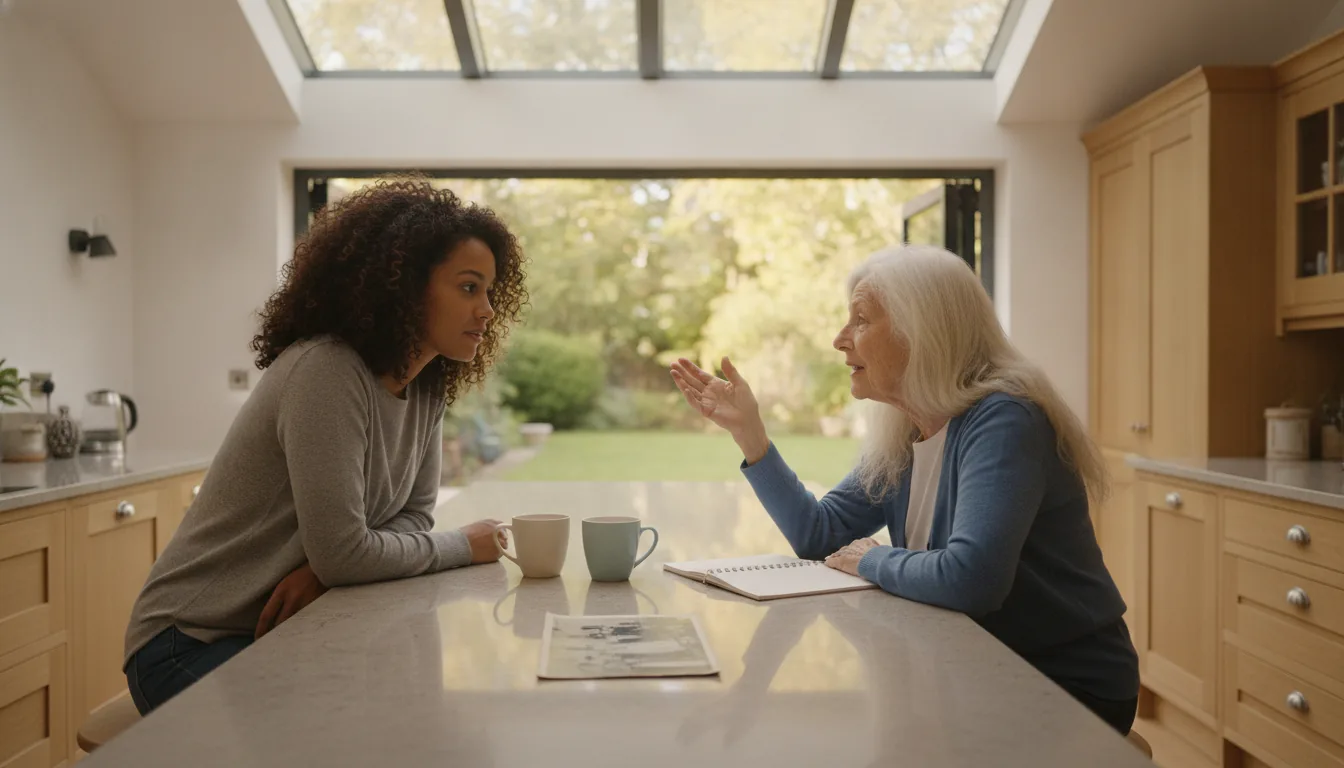
The wartime memories your grandparent carries are among the family stories most at risk of disappearing. The generation that remembers the Second World War from the inside — children during the Blitz, teenagers during VE Day, young adults who did National Service in the years that followed — are now in their late eighties and nineties. Many of them have never been asked the right questions. Not because their families don't care, but because nobody sat down and worked out what to ask, or found a moment that felt natural enough to begin.
With Remembrance Sunday approaching, this is one of those moments. So is any quiet afternoon, given the right question and a little time. Here is how to have the conversation — and what to do with it once you have.
In brief:
- The generation that remembers the Second World War and its aftermath is now in its late eighties and nineties. The window for capturing these memories is closing.
- Most wartime stories have never been told in full — not because they are secret, but because nobody asked the right questions.
- The best approach is indirect: start with small details of daily life, not the war itself.
- Recording is simpler than most people think, and far better than relying on memory.
- Remembrance is more personal when it is attached to a name, a face, a specific story from your own family.
Why wartime memories are different to other family history
Not every grandparent has wartime memories in the most direct sense — not everyone was old enough to serve, not everyone was in a theatre of war, and not everyone wants to talk about what they witnessed. But almost every British family of that generation was touched by the war in some way: evacuation, rationing, bereavement, the long shadow of a decade in which everything was uncertain and the news from the wireless determined the mood of a household.
These are not the stories that make it into history books. They are the underneath of history — the way a particular evening felt when the sirens went off, the women at the factory during the years when the men were gone, the telegram that arrived on a Wednesday morning and changed everything. They exist in one person's memory and nowhere else. And they are disappearing at a rate that is genuinely alarming, once you start to think about it.
The other thing that makes wartime memories different is that they are often not freely offered. Many people who lived through difficult periods have spent decades learning not to lead with them. They are not being evasive; they are simply accustomed to rooms where no one was asking. Asking changes things. Most people, once properly invited, have rather a lot to say.
How to approach the conversation
The most common mistake is trying to start with the war itself. What was it like during the Blitz? Did you know anyone who died? These questions tend to produce short answers and uncomfortable pauses — not because the memories aren't there, but because they are so large that it's hard to know where to take hold of them.
A more useful approach is to come at the same period through smaller doors. The ordinary details of daily life in the 1940s are not only easier to access — they tend to pull the bigger stories in with them. Ask about the school they went to during the war. The particular food they remember eating. The first time they heard something on the wireless that made the grown-ups go quiet. These granular, specific questions open the conversation gently, and the more emotionally significant memories tend to surface naturally once the person is in the flow of talking.
It also helps to signal genuine curiosity rather than polite interest. Most older people can read the difference between an audience that is tolerating and one that is actually listening. A specific question — I've always wondered what it was like at school when the evacuees arrived — signals something different from tell me about the war. The more particular the question, the more particular the answer.
Questions to ask your grandparent about their wartime memories
These work best as starting points rather than a list to work through. Pick one, listen closely, and let it lead where it leads.
On childhood during the war
- Where were you when war was declared, and who told you?
- Were you evacuated? If so, what do you remember about arriving somewhere you'd never been?
- What changed at home when the war began?
- What did you eat — and what was rationed, and what did people find to put in its place?
- What was school like during those years?
On family and community
- Was there anyone in the family who served? What do you remember about them leaving — or coming back?
- Did you lose anyone?
- What was the atmosphere like in your street? How did people treat each other when things were difficult?
- What did the adults not talk about in front of the children?
On the end of the war and what came after
- Where were you on VE Day? What do you remember about it?
- What was different afterwards — and what stayed the same?
- When did things feel normal again?
On what it taught them
- Is there something you understood about life from those years that you think people who grew up later don't quite grasp?
- What do you wish had been recorded — or preserved — from that time?
That last question has a way of opening things up. People who have thought about what is lost often know exactly what they would have wanted to save.
What to do with what you hear
Write down the names of people mentioned as you go, or immediately afterwards — these are the details that slip. Note the places. If you can record the conversation — even just the audio on a phone, on the table between you — do so. The texture of a voice telling a wartime story is irreplaceable in a way a transcript cannot quite capture. The pauses, the moments where someone has to stop and collect themselves, the laugh that comes unexpectedly — these are things that only exist in the recording.
If there is more here than a single afternoon's conversation — if you find yourself realising that this person's life, not just their wartime memories but the whole of it, is something worth capturing properly — that is the beginning of a memoir. Chronicle's guided sessions are built for exactly this kind of material: the stories that have never quite been told, drawn out by someone outside the family who knows how to ask and how to listen.
Find out how Chronicle works if you are thinking about doing this seriously. Or start with the lighter approach: the questions to ask your grandparents post covers the broader conversation, and how to interview your parent goes into the practicalities of making the recording feel natural. The wartime chapter is often the richest one. It is also usually the last to be asked about.
Further reading: 10 questions to ask your grandparents while you still can · The 20 best family history interview questions · Before it's too late: how to record your parent's life story