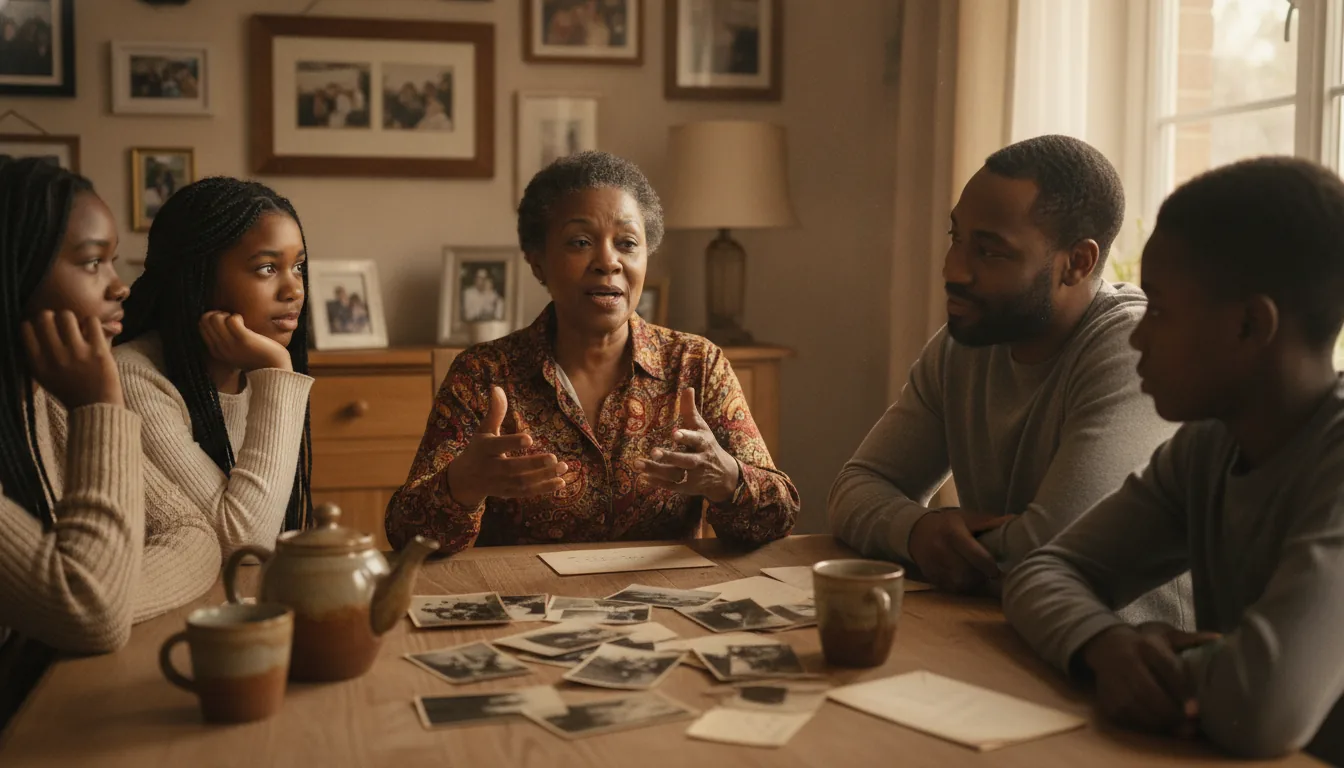
The stories that are hardest to preserve are the ones that exist in only one place: in the memory of a person who came from somewhere else. A grandmother who left Lagos at twenty-two. A grandfather who arrived in Leicester from Punjab in 1963. A great-aunt who grew up in rural Jamaica and still speaks of it with a specificity no one else in the family can match. These stories don't just describe individual lives — they carry an entire world that would otherwise be invisible to the generations who come after.
And they are more at risk than most people realise.
In brief:
- Family stories from another country are among the most at-risk of being lost — they exist in one generation and rarely in any written record.
- The first generation holds not just personal memories but the texture of a whole world: language, landscape, culture, a way of life that no longer exists in the same form.
- Waiting is the main risk. These stories don't fade gradually — they are simply there, and then they are gone.
- Voice recordings preserve what written accounts cannot: accent, cadence, the specific way a person tells a story.
- A guided process works better than sitting someone down and asking them to remember — the right questions open the right rooms.
- The time to begin is before the first generation is gone, not after.
What the first generation carries that no one else does
Every family that moved from one country to another carries two histories: the history of where they came from, and the history of what they built when they arrived. Both are worth preserving. But the history of where they came from is the one that disappears fastest — because only the first generation lived it.
What is lost when a first-generation parent or grandparent dies without their story being recorded is not just personal memory. It is the texture of an entire world. What the village looked like. What the food tasted like. What daily life was in a place that may have changed beyond recognition — or that no longer exists at all. The journey that brought them here, and what that crossing cost them. What they expected to find, and what they actually found.
Their children know some of this. Their grandchildren know fragments of it. By the time a family reaches the third generation in a new country, the origin story has often become a legend — a few repeated phrases, a handful of photographs, a country of origin that feels increasingly abstract. The specific, irreplaceable detail — the kind you can only get from someone who was there — is gone.
Why these stories are harder to capture than most
Oral tradition is not a backup system. It is a living practice — stories told in the right context, in the right language, between people who share enough common ground to understand what is being said. When a family moves, that context changes. The language shifts. The references stop landing. Stories that would have been told naturally at home, in a village, at a gathering, find no obvious moment to be told in a new country where life runs differently.
There is also a particular reticence that tends to come with the generation that made the crossing. Many first-generation migrants do not consider their own story remarkable — they were doing what they had to do, and they got on with it. The idea that someone would want to sit down and hear about their life in detail, and preserve it in a book, can feel strange to them. It takes the right frame, and usually the right family member, to make it feel natural.
That is why guided conversation works better than a direct request to "tell me your story." The right questions open the right rooms. Asked about the house they grew up in, people describe it in astonishing detail — the smell of it, who slept where, the view from the window. Asked about their journey here, they remember things they have not thought about in decades. The conversation does the work; the questions are the key.
For a set of questions designed to open exactly these kinds of conversations, The 20 best family history interview questions gives a practical structure that works across any cultural background.
What voice recordings preserve that writing cannot
There is something specific to the first generation's way of telling a story that cannot be fully captured in a written transcript: the accent, the cadence, the particular rhythm of a language being translated in real time. A grandmother who grew up speaking Yoruba and then English will tell a story differently from anyone who learned English from birth. That difference — the specific music of it — is as much a part of the story as the events themselves.
Audio recordings preserve this when written accounts cannot. And the question of language matters practically too: many first-generation parents and grandparents are more fluent, more vivid, more themselves in their first language than in English. A recording process that can work in any language — that follows the person rather than asking them to perform in a second tongue — will capture something a written questionnaire never could.
This is explored in more depth in Why your parents' voice is the most irreplaceable thing you'll never think to save — the principle applies to every family, but it matters most when the voice carries an accent and a cadence that belong to a world the rest of the family has never seen.
The practical question of when to start
The honest answer is: earlier than feels necessary.
First-generation parents and grandparents tend to be more robust than the rest of the family assumes — and then, suddenly, they are not. The window is not as long as it appears. Health changes quickly in later life. Clarity of memory, while still intact, is not guaranteed indefinitely. The stories that feel safe to capture next year may be harder to reach next year than they are today.
There is also a practical point about willingness. People who feel healthy and engaged are generally more willing to sit down and talk at length about their lives than people who are unwell, tired, or aware that time is short. The version of the story you get from a 75-year-old who is entirely themselves is a different and fuller version than the one you might get at 82.
The time to begin, in almost every case, is now.
Chronicle is built for exactly this situation — guided conversation in any language, shaped into chapters, produced as a hardcover book that every generation of the family can hold. It doesn't require anyone to be a writer, or to know how to structure a memoir. It requires only that someone sits down and talks.
What you are preserving
When a first-generation family member's story is captured properly, what the family receives is not just a memoir. It is a bridge. A document that makes the origin story specific and real rather than vague and legendary. Something a grandchild can read and think: this is where I come from. This is what it actually looked like. This is the person who made the crossing.
That is worth more than most families realise — until the moment they no longer have the chance to make it.
For more on what a finished life story looks like and the formats it can take, What Is a Life Story Book covers the options clearly.